
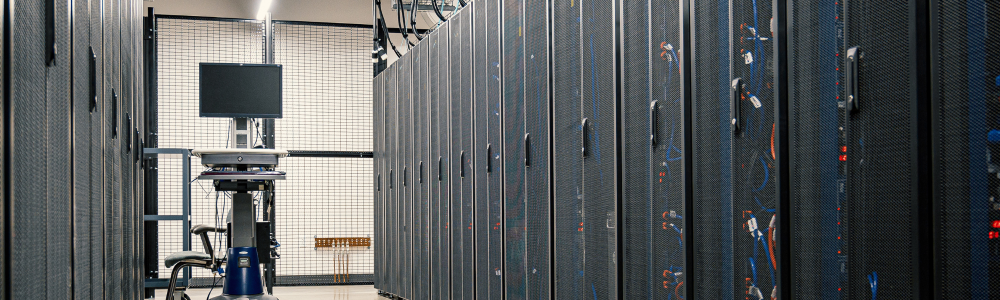
As organizations migrate to cloud platforms and roll out more powerful new hardware, the demand for high-density data centres has surged. The increased development in AI technologies has accelerated this trend, as AI workloads require significantly more processing power. In BC, this is particularly prominent in areas like Vancouver and the Lower Mainland, where space is limited and regulations are stringent. Add in the technical complexity of upgrading older buildings, and it’s clear why building or modernizing data centres in these urban hubs can be a challenge.
Vancouver Data Centres
Building data centres downtown comes with big perks, but also big challenges. Being close to end-users means faster connections and reduced latency, and city locations often have strong fibre networks and easy access to corporate offices. Vancouver holds a strategic advantage in this regard, as it serves as a landing point for multiple transoceanic communication cables connecting North America to Asia-Pacific markets, positioning the region as a critical hub for data transmission. However, these benefits come with trade-offs. Many downtown buildings are older and may have outdated systems and limited space. Add strict urban zoning rules to the mix, and the job gets even tougher. For construction teams, this means juggling tight spaces, complex regulations, and tricky logistics while keeping businesses running smoothly.
IDR has faced these challenges head-on. With several major data centre projects completed in the Lower Mainland, we’ve developed a reputation for precision, adaptability, and technical excellence in data centre construction.
The Technical Demands of Modern Data Centers
Data centre construction requires specialized expertise that differs from commercial office renovation. The shift toward higher-density builds, where smaller, more powerful hardware packs more computing power into less space, has transformed the design and engineering requirements.
Key considerations for data centre construction include:
Cooling Systems: High-density equipment generates a significant amount of heat. Liquid cooling, hot and cold aisle containment, and other advanced cooling systems are essential to maintain optimal operating conditions and prevent the area from overheating.
Power Infrastructure: Modern data centres require powerful electrical systems capable of supporting fluctuating loads and redundancy for uninterrupted uptime.
Physical Security: Beyond cybersecurity, physical security measures, such as reinforced walls and security mesh, bulletproof glazing, specialized door hardware, cameras and sensors, are utilized to protect sensitive hardware.
Scalability: As technology constantly evolves, we need to design facilities that can accommodate future upgrades with minimal operational disruption.
Many businesses in Vancouver are discovering that older data centre spaces are no longer sufficient for their needs. Rooms built for bulky servers now sit half-empty because hardware is smaller but much more powerful. That means retrofitting for higher density, which takes planning, expertise, and precision.
Case in Point: Spencer Building Carrier Hotel
One of our recent data centre projects is the Spencer Building Carrier Hotel, located within the historical Spencer Building that’s been part of Vancouver’s Waterfront since 1926, adjacent to the Harbour Centre landmark. This facility is one of Vancouver’s most advanced and sustainable data centres, addressing the growing demand for IT capacity driven by cloud computing, 5G networks, and IoT technologies.
Working in a heritage building requires careful planning to integrate modern systems without compromising the structural integrity. Space constraints and the need to maintain uninterrupted business operations added further complexity.
Phase One focused on installing critical mechanical systems to support the centre’s cooling requirements, such as three large chillers and an extensive network of interior piping. Advanced 3D modelling and virtual design tools played a key role in planning the installations, allowing teams to identify and then resolve potential issues before construction began.
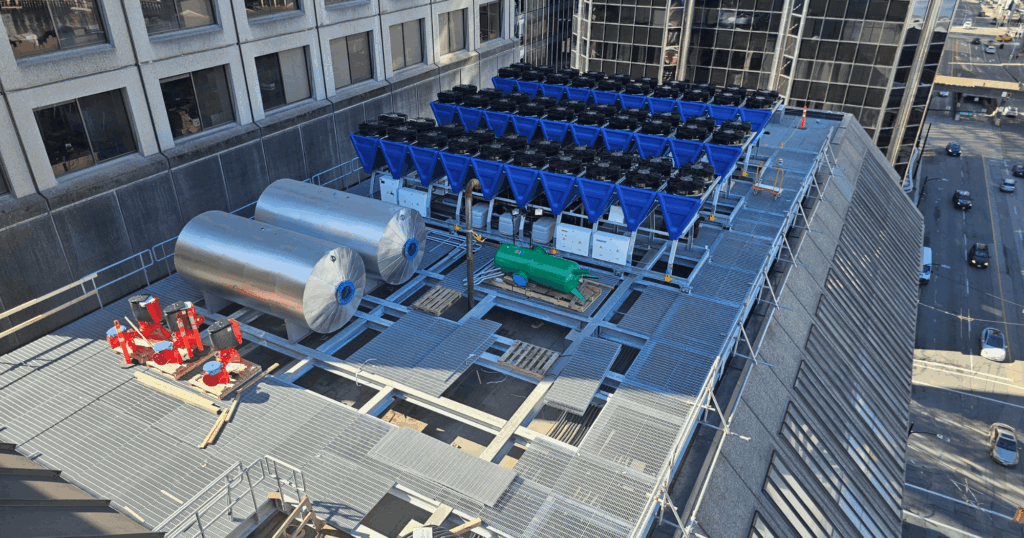
Upgrading the Spencer Building Carrier Hotel wasn’t just about installing new systems. Working within a heritage property in one of the city’s busiest areas meant managing far more than budgets and timelines. The project required an orchestration of permits, public safety measures, and precision planning for large-scale equipment lifts. Delivering chillers, generators, and electrical units to upper floors involved overnight crane operations, strict traffic control plans, and coordination with city authorities, transit providers, and multiple stakeholders. Limited staging areas and narrow streets added to the complexity, demanding meticulous scheduling and communication to minimize disruption for tenants and the public.
Collaboration played a key role in the project’s success. We worked alongside partners such as Black & McDonald, whose expertise in mechanical installations ensured precision and reliability throughout the first phase. This partnership demonstrates how integrated planning and shared technical expertise can overcome the challenges of building advanced infrastructure in a densely populated urban setting.
Future Trends in Data Center Construction
Looking ahead, several trends are shaping data centre construction in Vancouver and beyond:
Sustainability
Energy consumption is one of the biggest challenges for modern data centres. Operators are increasingly adopting renewable energy sources and advanced cooling technologies to reduce their carbon footprint. In Vancouver, where sustainability standards are high, these measures are becoming essential for compliance and long-term operational efficiency.
AI and High-Density Hardware
The rise of AI workloads is reshaping data centre design. Rack densities are projected to exceed 200 kW in the coming years, creating unprecedented demands for power and cooling. This requires construction teams to plan for scalable infrastructure that can handle these loads without compromising reliability.
Hybrid Cloud Integration
As businesses adopt hybrid cloud strategies, data centres must support seamless connectivity between on-premises systems and cloud environments. This means designing flexible network and power architectures that can adapt to changing workloads and integration requirements.
For organizations in Vancouver and the Lower Mainland, understanding these trends is critical. Partnering with a construction manager who can anticipate and address these challenges ensures that facilities remain efficient, secure, and future-ready.
Data Centre Construction with IDR
Data centres are an integral part of enabling digital transformation, and building or upgrading them requires far more than available space. These projects demand strategic planning, technical precision, and flawless execution. In dense urban environments like Vancouver, the challenges multiply; construction management must maintain tight footprints, comply with regulatory requirements, and manage complex logistics without disrupting surrounding operations. Success depends on collaboration with experienced partners who understand these dynamics and can coordinate across multiple disciplines. By working with experts in construction management, organizations can ensure their infrastructure is resilient, efficient, and ready to meet the demands of an increasingly data-driven world.
Reach out to our team if you would like to learn more about our work in data centre construction.